How to choose a way to gather data for a class project or a work report
Data collection is the step where you gather the facts your project depends on. It might be answers from people, notes on what people do, or numbers that already exist somewhere. The method you pick decides what you can claim at the end, so it's worth choosing on purpose.
Most student and workplace projects use one of four methods, or a mix of two. They are surveys, interviews, observation and existing records. This guide compares them, shows you how to write a one-page plan, and fixes one vague survey question so it collects something useful.
Start with the question, not the method
Write down the one question your project has to answer. Make it specific enough that you'd know when you had the answer.
"How do students feel about the library" is too broad. "Why do first-year students leave the library before 8 pm on weeknights" gives you something to collect. At work, "Is onboarding good" is too broad. "Which onboarding step do new hires repeat or ask about most in their first two weeks" is something you can measure.
Then ask yourself two things. Do you need numbers, such as how many or how often? Or do you need reasons, such as why and how? Numbers point toward surveys and records. Reasons point toward interviews and observation.
Surveys
A survey asks many people the same set of questions. It's the usual choice when you want to count something across a group.
Surveys work well for opinions, habits and simple facts that people know about themselves. They're cheap to send and easy to total in a spreadsheet. A class project can reach a full year group with one shared form. A team at work can reach every customer who opened a support ticket last month.
The weakness is depth. People skim, skip questions and pick the first answer that seems close enough. You also only hear from the people who chose to reply, and they may not be typical of the whole group.
Use a survey when you need to compare groups or track a number over time. Keep it short enough to finish in a few minutes.
Interviews
An interview is a conversation with one person, guided by a short list of open questions. It's the method for finding out why.
You can follow up on a surprising answer and ask for an example. That's how you learn the reasons behind a number. Five to ten interviews often show you the main themes in a small project.
Interviews take time to book, run and write up. What you get is also harder to count, because each person answers in their own words. And people sometimes tell an interviewer what they think the interviewer wants to hear.
Use interviews early to discover what to ask in a survey, or late to explain a survey result you didn't expect.
Observation
Observation means watching what people actually do and writing it down. You might sit in a cafeteria and record which queue moves slowest. Or you might watch three colleagues use a new tool and note every point where they stop.
Its strength is that it shows behavior instead of memory. People are often wrong about their own habits. A survey says customers read the instructions. Watching them shows they don't.
The trade off is effort and focus. You can only watch a few people at a time, and your presence can change how they act. Decide in advance exactly what you'll record, or your notes will drift toward whatever caught your eye.
Use observation when the behavior is visible and you suspect people's own accounts are unreliable.
Existing records
Existing records are data someone else already collected. For students, that might be public statistics, attendance logs or published datasets. At work, it could be sales figures, support tickets, website analytics or past survey results.
Records are often the quickest place to start because nobody has to answer anything new. They can cover months or years, which no survey of yours can match.
The catch is that they were collected for another purpose. Categories may not match your question, fields may be blank, and definitions may have changed over time. Check how the data was recorded before you trust a trend in it, and get permission before you use anything internal or personal.
Use records first whenever they exist. They often answer half the question and tell you what still needs asking.
Comparing the four at a glance
| Method | Good for | Watch out for | Typical effort |
|---|---|---|---|
| Survey | How many and how often across a group | Shallow answers and who chooses to reply | Low per person |
| Interview | Reasons, stories and surprises | Time to run and harder to count | High per person |
| Observation | What people really do | Small samples and changed behavior | High per session |
| Existing records | Trends over time with no new asking | Gaps and mismatched categories | Low to start |
A one-page data collection plan you can copy
Fill in this plan before you collect anything. It keeps the project small enough to finish and gives your teacher or manager something concrete to approve.
DATA COLLECTION PLAN

Project question:
  Why do first-year students leave the library before 8 pm on weeknights?

What I need to know:
  1. How many first-years use the library on weeknights, and when they leave
  2. The main reasons they give for leaving
  3. What the space is like in the evening

Methods:
  Records      Door counter data by hour for the last 8 weeks, from library staff
  Survey       8 questions, sent to first-years through the class group chat
  Interviews   5 students who answered the survey and agreed to talk, 15 minutes each
  Observation  2 weeknight visits, 6 pm to 9 pm, noting noise, seating and lighting

Who and how many:
  Survey target 60 responses. Interviews 5. Observation 2 evenings.

Consent and privacy:
  Survey is anonymous. Interview notes use first initials only.
  Staff approved use of door counter data.

Schedule:
  Week 1  Get records, write and pilot the survey with 3 classmates
  Week 2  Send survey, run observation visits
  Week 3  Interviews, close survey
  Week 4  Analyze and write up

How I will analyze it:
  Records and survey in a spreadsheet, counted by hour and reason.
  Interviews and observation notes sorted into themes.

What would change my plan:
  Fewer than 30 survey replies means a second reminder and two more interviews.
The same layout works at work. Swap the question for something like "Which onboarding step causes the most repeat questions," use the help desk tickets as records, and interview a handful of recent hires.
Rewriting a vague survey question
A survey is only as good as its questions. Here is a common one that looks fine and collects almost nothing.
Before: How satisfied are you with the library and its services and hours?
It asks about three things at once, so you can't tell which one an answer refers to. "Satisfied" means something different to every reader. There's no time frame, and the reply options aren't clear.
Here is the same idea split and tightened.
After:  In the past two weeks, how often did you leave the library earlier than you planned?
        Never / Once / 2 to 3 times / 4 or more times

Follow-up, if not Never:
        What was the main reason you left early? Choose one.
        Too noisy / No free seats / Closing time / Too cold or warm / Other, please say
Each question now covers one thing, uses a fixed time frame, and gives options that don't overlap. You can count the answers and compare groups. When you're stuck on a question that keeps coming out wordy, a free rewriter for clearer questions can suggest a few plainer versions to choose from.
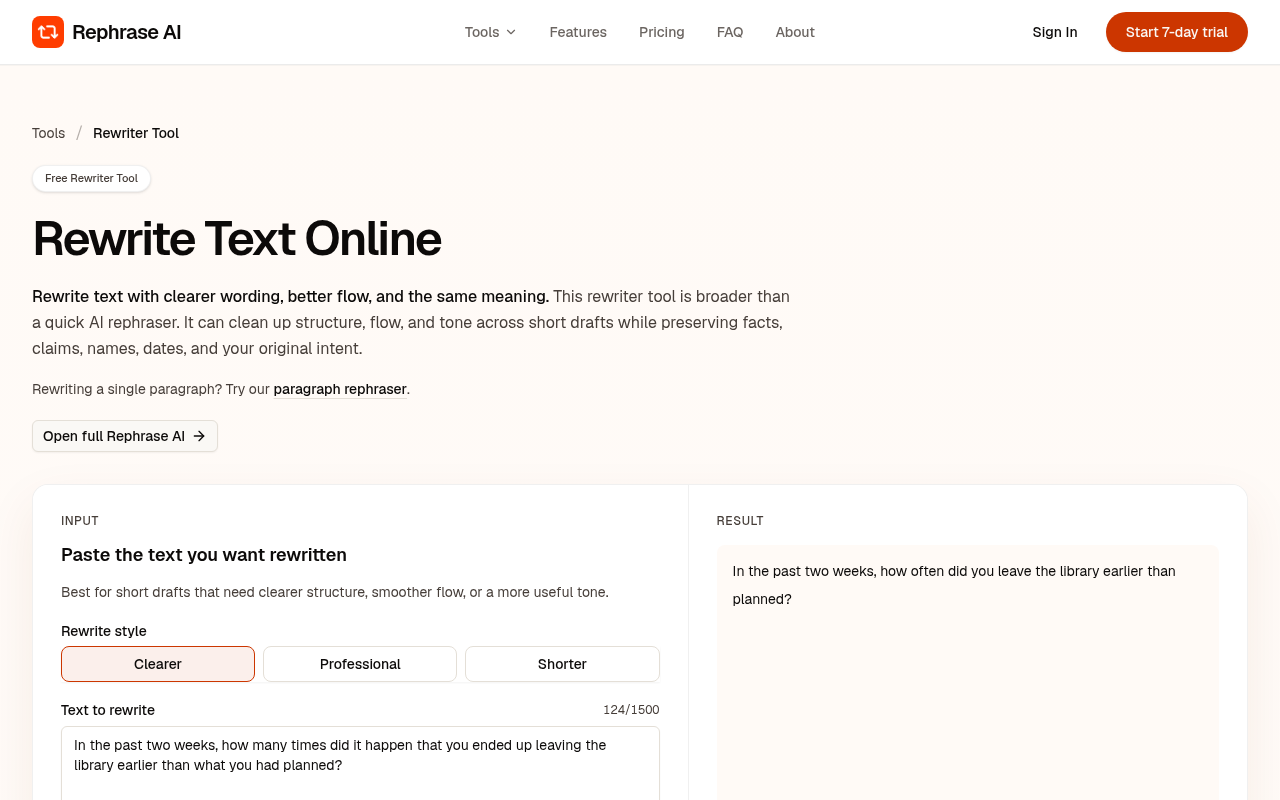
Putting a wordy library survey question through Rephrase AI's rewriter tool on Clearer.
Test before you send
Pilot every survey or interview guide with two or three people from your group before the real launch. Watch where they hesitate or ask what you meant. Fix those spots, then send it.
Write up your method as you go. Note what you collected, when, from whom and anything that went wrong. That record is what lets a reader trust your result.
If you're writing up the findings afterward and a paragraph reads stiffly, Rephrase AI can offer a few other wordings to compare, while the numbers stay yours to check.
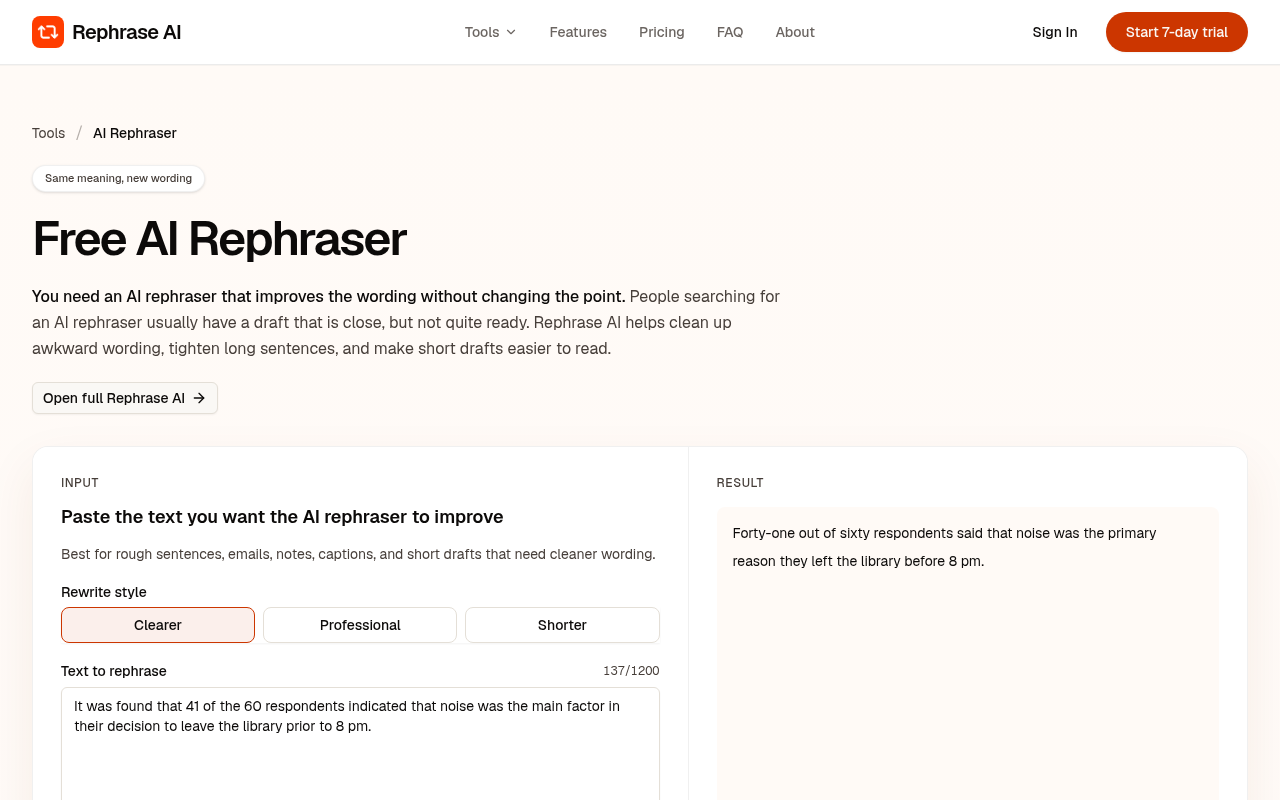
Rewording a stiff survey finding about library noise with Rephrase AI's AI Rephraser on Clearer.