By Tour.af
Most travel advice about Mazar-i-Sharif treats it as a stop: a day for the Blue Mosque and a morning in Balkh on the way west to Herat. That is a perfectly good way to see it. But the city has one moment in the year when it becomes the destination rather than a stop, and that is the arrival of spring. Nawroz, the new year at the spring equinox around 21 March, has long been closely tied to Mazar-i-Sharif and its shrine.
This article looks at Mazar-i-Sharif in spring: what Nawroz means there, what to see around it, and how to plan a trip in March and April with a licensed operator. Background on the city is drawn from Tour.af's Mazar-i-Sharif guide.
The city and its shrine
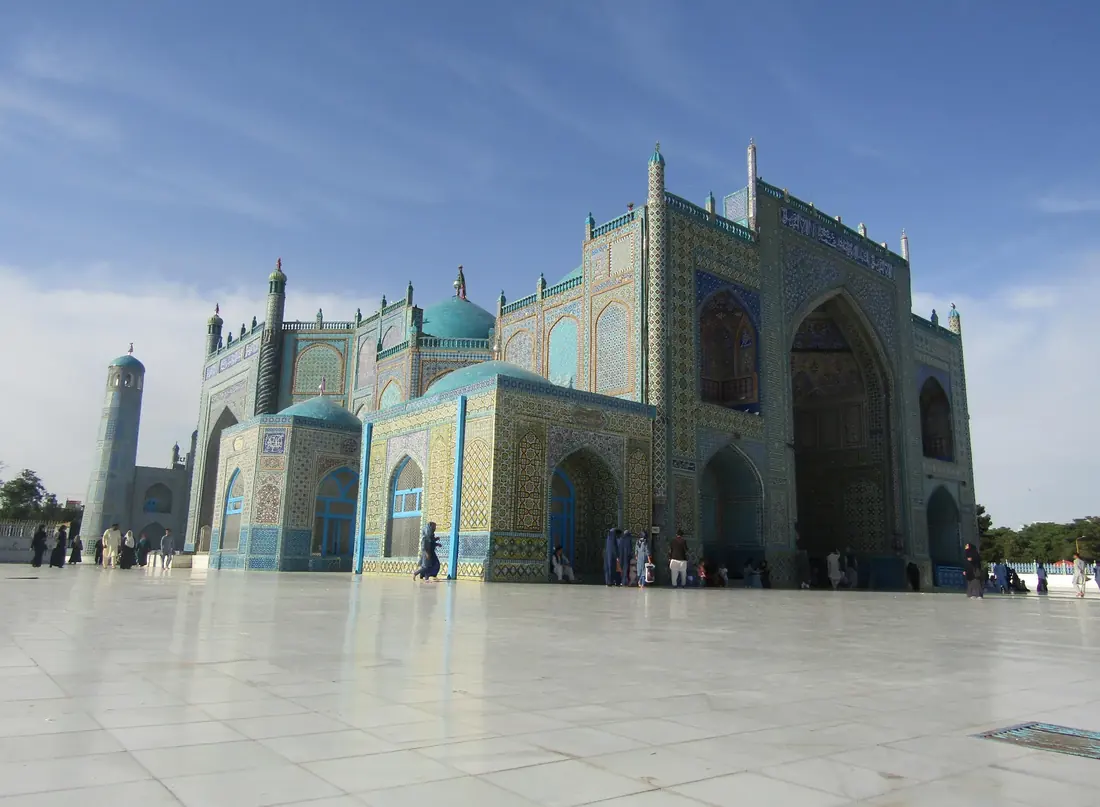
Mazar-i-Sharif means "noble shrine." The city grew around the shrine at its centre, the Blue Mosque, known as the Shrine of Hazrat Ali. Tradition holds that Hazrat Ali, the cousin and son-in-law of the Prophet Muhammad, is buried here, which made the city one of the holiest Islamic sites in Afghanistan, as well as a hub for trade between Central Asia and the Indian subcontinent.
The mosque itself is the reason most visitors come: turquoise tilework over every surface, large domes, and peaceful courtyards where pilgrims and families gather. It is the heart of the city in both a physical and a social sense.
Nawroz and the Janda
Nawroz marks the start of spring. Tour.af's Mazar guide describes the Blue Mosque as a major pilgrimage destination especially during the annual Nawroz celebrations, which have traditionally drawn thousands of people to watch the raising of the Janda, a flag, at the shrine, a symbol of hope and renewal. The guide also describes public celebrations with traditional music near the mosque.
A sensible note on timing: how Nawroz is marked in public can change from year to year, and a visitor should not plan around a particular ceremony on a particular day without confirming it first. Ask your operator what is expected for your dates before you book flights around it. The season is worth visiting either way.

Why spring suits the north
Tour.af's guide names spring, March to May, as the best time to visit Mazar-i-Sharif, "especially during Nawroz," with autumn, September to November, as the other pleasant window. Summers in the north can be extremely hot, with temperatures that can go above 40°C, so spring and autumn are the comfortable seasons for walking around courtyards and ruins.
What to see around Nawroz
The Blue Mosque. Give it time. Courtyards change character across the day, and in spring the city's attention is focused here.
Balkh. About twenty kilometres from Mazar-i-Sharif, Balkh, ancient Bactria, is often called the "Mother of Cities." It was once a major centre of Buddhism and Zoroastrianism, and its ruins of temples, fortresses and mausoleums make a natural half-day or morning. The City of Balkh is on Afghanistan's UNESCO Tentative List.
The bazaar. Mazar's markets sell handwoven rugs, saffron, traditional jewellery, ceramics and pottery. Prices are negotiated, and your guide can help.
A teahouse. Green tea is a staple of Afghan hospitality. An hour in a teahouse is often the most memorable part of a day in a pilgrimage city.
The food. Tour.af's guide suggests Kabuli pulao, qorma, mantu and, on a warm afternoon, sheer yakh, a local ice cream.
Getting there and getting around
Tour.af's guide describes flying from Kabul to Mazar-i-Sharif International Airport as the easiest way to reach the city. In town, taxis are the usual way to get around, and many key sights are walkable from the centre, with your guide. Dari and Uzbek are the most widely spoken languages, with Pashto also heard; English is less common outside hotels and among guides.
Under current rules every foreign tourist must travel with an official translator, and independent sightseeing is not allowed. Mazar must also be on your travel permit, which names the provinces on your route. A tourist e-visa alone does not cover it.
Fitting Mazar-i-Sharif into a spring trip
There are two straightforward ways to include the city.
On a Silk Road itinerary. Tour.af's ten-day Silk Road Highlights small-group trip, $2,499, runs from Kabul to Bamiyan, then north to Balkh and Mazar-i-Sharif, finishing in Herat. The Silk Road Journey through Kabul, Bamiyan, Balkh and Herat is a distinct ten-day itinerary at $2,990. Fixed departures have set dates, so check whether one falls in spring.
As a private quote. If you want to be in Mazar in March, the simplest route is a private itinerary built around your dates. Tell the operator at the quote stage, so the route and the permit are written correctly. The letter of invitation and permits come with a Tour.af quote.
Practical notes for a spring visit
- Dress modestly, especially at the shrine; follow your guide's lead on where photography is welcome.
- Carry cash. Most transactions in the markets are in physical money, and cards are rarely useful.
- Pack layers. Spring days can be warm and evenings cool.
- Book early if you want specific dates around the new year, and keep a flexible day in the plan.
Mazar-i-Sharif rewards a slower pace than a one-day stop allows. In spring, with the new year and the shrine at the centre of the city's attention, it is worth giving the north a little more of your trip.
Current itineraries are on the Afghanistan tours page.
Tour.af, Ahmad Shah Baba Mena, Kabul 1012, Afghanistan. +93 70 521 4101. WhatsApp · tour.af
Written with AI assistance and reviewed by Tour.af against its published Mazar-i-Sharif destination page and tour pages.